Water in your basement is more than an inconvenience. It destroys stored belongings, promotes mold growth, weakens your foundation, and can reduce your home’s value by 10 to 25 percent. The good news is that most basement water problems have straightforward drainage solutions.
This guide explains why basements get wet, which solutions actually work, and how to prioritize your waterproofing strategy.
Why Basements Get Wet
Basement water comes from three sources: surface water that is not being directed away from the house, groundwater that rises to the level of the basement floor, and water vapor that migrates through the concrete walls and floor.
Surface Water Problems
If your gutters overflow, your downspouts discharge next to the foundation, or the ground around your house slopes toward the foundation, surface water is saturating the soil next to your basement walls. This water then pushes through cracks, joints, and porous concrete by hydrostatic pressure.
The fix: Correct the exterior grading, extend downspouts, and install a French drain or curtain drain to intercept water before it reaches the foundation.
Groundwater Problems
If your basement is wet even during dry weather, or if water seeps up through the floor or through the wall-floor joint (called the cove joint), you likely have a high water table problem. This is common in low-lying areas, near rivers or lakes, or in areas with clay soil that holds water close to the surface.
The fix: An interior perimeter drain (also called a “drain tile system”) or an exterior footing drain connected to a sump pump.
Water Vapor Problems
If your basement walls feel damp but you cannot find any specific water entry point, moisture may be migrating through the concrete as water vapor. This is especially common in older homes without a vapor barrier.
The fix: Interior waterproof coatings, a vapor barrier membrane, or a dehumidifier for mild cases.
The Right Order of Operations
Waterproofing your basement is like medicine: start with the least invasive treatment and escalate only if needed.
Step 1: Fix the Exterior (Free to Low Cost)
Before spending thousands on interior waterproofing, make sure you are not sending water toward your foundation:
- Clean your gutters. Overflowing gutters dump water directly against the foundation.
- Extend downspouts. Move discharge points at least 4 feet from the foundation, preferably 10 feet via underground extensions.
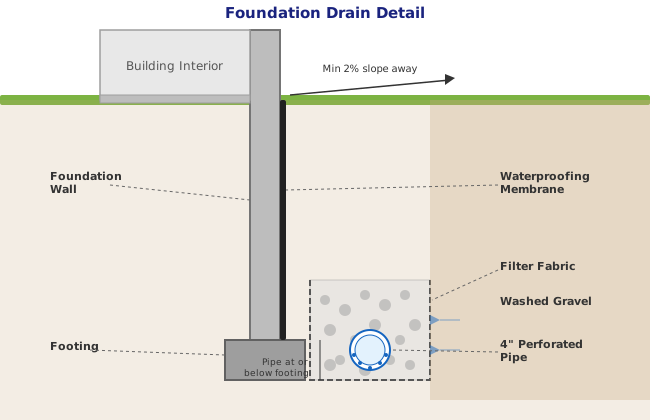
- Fix the grading. The ground should slope away from the house at 2 percent (a quarter inch per foot) for at least the first 6 feet.
- Seal obvious cracks. Use hydraulic cement for active leaks and polyurethane caulk for dormant cracks.
These four steps solve the majority of residential basement water problems and cost very little.
Step 2: Exterior Drainage (Moderate Cost)
If Step 1 does not solve the problem, the next step is intercepting water before it reaches the foundation:
- Curtain drain. A French drain installed uphill from the foundation to intercept subsurface water flowing toward the house.
- Footing drain. A perforated pipe installed at the base of the foundation footing, covered in gravel, to collect water that reaches the foundation and route it to a sump or daylight outlet.
Use the Foundation Drain Calculator to size your exterior drainage system.
Step 3: Interior Drainage (Higher Cost)
If exterior solutions are not feasible (for example, the exterior footing is inaccessible due to porches, sidewalks, or neighboring structures), an interior perimeter drain can collect water that enters the basement and route it to a sump pump:
- Break out the perimeter. A channel is jackhammered along the interior perimeter of the basement floor, 6 to 12 inches from the wall.
- Install drain pipe. Perforated pipe is placed in the channel, surrounded by gravel.
- Connect to sump. The perimeter drain routes water to a sump pit with a submersible pump.
- Patch the floor. The channel is covered with new concrete.
This is a significant investment ($5,000 to $15,000 for a full basement) but it is highly effective for chronic water problems.
Sump Pumps: Your Last Line of Defense
Every basement with a water history should have a sump pump. The pump collects water from the perimeter drain or the water table and pumps it up and out, discharging it away from the house.
Primary pump: A 1/3 to 1/2 horsepower submersible pump handles most residential needs. Size the pump for the expected flow rate and the total dynamic head (vertical lift plus pipe friction).
Battery backup: A battery-powered backup pump runs during power outages, which tend to coincide with the worst storms. This is not optional if your basement has valuable contents.
Use the Sump Pump Calculator to determine the right pump size for your basement.
Waterproof Coatings and Membranes
Interior coatings. Crystalline waterproofing compounds (like Xypex or Krystol) are mixed into a slurry and painted onto the interior of concrete walls. They react with moisture and form crystals that seal the pores in the concrete. Effective for vapor migration, less effective for hydrostatic pressure.
Exterior membranes. Sheet or spray-applied membranes on the exterior of the foundation wall are the most effective waterproofing method but require excavating around the foundation.
Cost Comparison
| Solution | Cost | Effectiveness |
|---|---|---|
| Downspout extensions | $10-50 each | High for surface water |
| Grading correction | $500-3,000 | High for surface water |
| Exterior French drain | $2,000-6,000 | High for subsurface water |
| Exterior footing drain | $5,000-12,000 | Very high |
| Interior perimeter drain + sump | $5,000-15,000 | Very high |
| Waterproof coating (interior) | $3-6/sq ft | Moderate |
| Full exterior waterproofing | $10,000-25,000 | Highest |
When to Call a Professional
Basement waterproofing is one of the most important situations where professional help is strongly recommended:
- Structural cracks. Horizontal cracks, stair-step cracks in block walls, or bowing walls indicate structural problems that require an engineer.
- Interior drain systems. Jackhammering a perimeter drain requires experience and proper equipment.
- Exterior excavation. Digging around a foundation to the footing level is dangerous and can undermine the foundation if done incorrectly.
- Sump pump installation. Incorrect installation can void warranties and fail when needed most.
- Mold remediation. If you have visible mold growth, address it with a certified mold remediation company before waterproofing.
Related Calculators
- Foundation Drain Calculator — Size perimeter drainage
- Sump Pump Calculator — Size sump pumps
- French Drain Calculator — Size curtain drains
- Downspout Calculator — Check downspout capacity